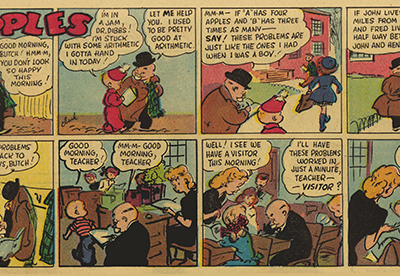
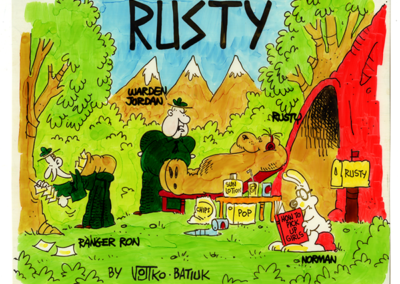
As the final year of John Darling Sunday strips unspooled, I really enjoyed seeing Bob Votjko’s art on the ...


In previous introductions to these collections, I’ve discussed the writing in terms of how it changed from gags to sitcoms to a more cinematic storytelling approach, and how that opened the work up to approaching more complex subjects and edge work. However, I’ve never really discussed the process other than from the outside looking in. Now I think I’ve done this long enough to understand what’s going on here, and to be able to examine and describe to some degree how things work on the inside. So, if you’re up for it, let’s take a whack at it. If you’re not, just skip ahead to the collected cartoons because everything you might want to know is already hiding there in plain sight.
When you first start work on a comic strip, your mindset tends to ping-pong from panicked to nervous breakdown. All you’re trying to do is weather the tornado of deadlines that are constantly circling you. I mentioned earlier about how I wanted to avoid easy crowd-pleasing material, but, in the beginning of your comic strip journey, you want all of the easy crowd-pleasing material you can conjure up. People would ask me how you come up with an idea every day and, as I previously mentioned way back in Volume 6, I would quip that I didn’t know, but that I had all day. But when the Jon Gnagy art kit that you bought as a kid isn’t bringing the art home the way you’d hoped, and you find yourself spending all day just trying to get the drawings to look right, you really don’t have all day to write. You have an hour. At least that’s the amount of time I would give myself each day. I would spend the whole day at the board, and then in the evening while Cathy watched TV, I’d head to the bedroom, plop on the bed, and write as many gags as I could in an hour. In a panic! I was so afraid of not coming up any ideas that I would bounce from one topic to another at light speed until I found a vein I could tap. The other trick was to never miss a day. Not one. You couldn’t afford it. I’d often think about the night in that back bedroom when I came up with Harry L. Dinkle, the World’s Greatest Band Director, and wonder what my career might have been like if I’d skipped that night and never come up with the strip’s first truly iconic character. As a result, whenever someone asked me for advice on writing, my response was always to write every single day without exception. I still will give that out as advice because it’s very sound advice, even though I personally don’t do that anymore. Now, I can sit for a couple of hours without coming up with any ideas—just rolling thoughts around and not writing down a thing. I’ll also go for weeks without writing and then spend a couple of weeks doing nothing but writing. It’s all a part of learning to trust the process. When that happens, everything slows down, and, as a result, writing becomes a pleasure. Although, truth be told, I will still wonder once in a while what I might be missing during those weeks when I’m not writing. Nevertheless, a day when I wake up with nothing to do but write is a good day. But I’m getting a little ahead of myself, so maybe it’s time for another novella-length digression while I regroup.
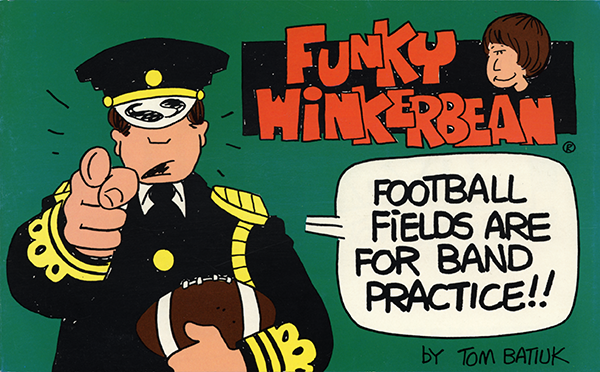
From The Complete Funky Winkerbean Volume 15